
Introduction
I'll be honest, back in early 2023 I had never heard of the Kokshaal-Too Range, nor so had I even really dived deep into the Kyrgyz wilderness in any way what so ever. At most I'd done a couple of multi day hikes in Ala-Archa National Park and to Kol-Tor Lake in the Kyrgyz Ala-Too Range. In fact, snow conditions that time of year meant most of the more remote regions were completely inaccessible for hiking with the high passes being completely snowed over.
Fortunately for me, and somewhat coincidentally, I found myself back in Kyrgyzstan later in the year, this time in a much better time for backcountry hiking, where I would meet a crazy guy from Colorado who was dedicating his 20's to building the largest thru-hike on the planet. And yes, this guy was Ian, fellow Co-Founder & Mountain Guide at Great Goat Expeditions. That summer, we did a bunch of awesome hikes across the Tien-Shan, pioneering shepherd trails for hikers. But, there was one mountain range Ian mentioned to me that stood out as being the wildest and must rugged across Kyrgyzstan, this was none other than the Western Kokshaal-Too Range.
Unfortunately, in the 2023 season we ran out of time to and we're unable to complete the Kokshaal Traverse, and 2024 season would see myself and Ian in different regions for large parts. But we vowed to finally attempt the hike in 2025, making it one of the most anticipated hikes of my life...
About The Western Kokshaal-Too
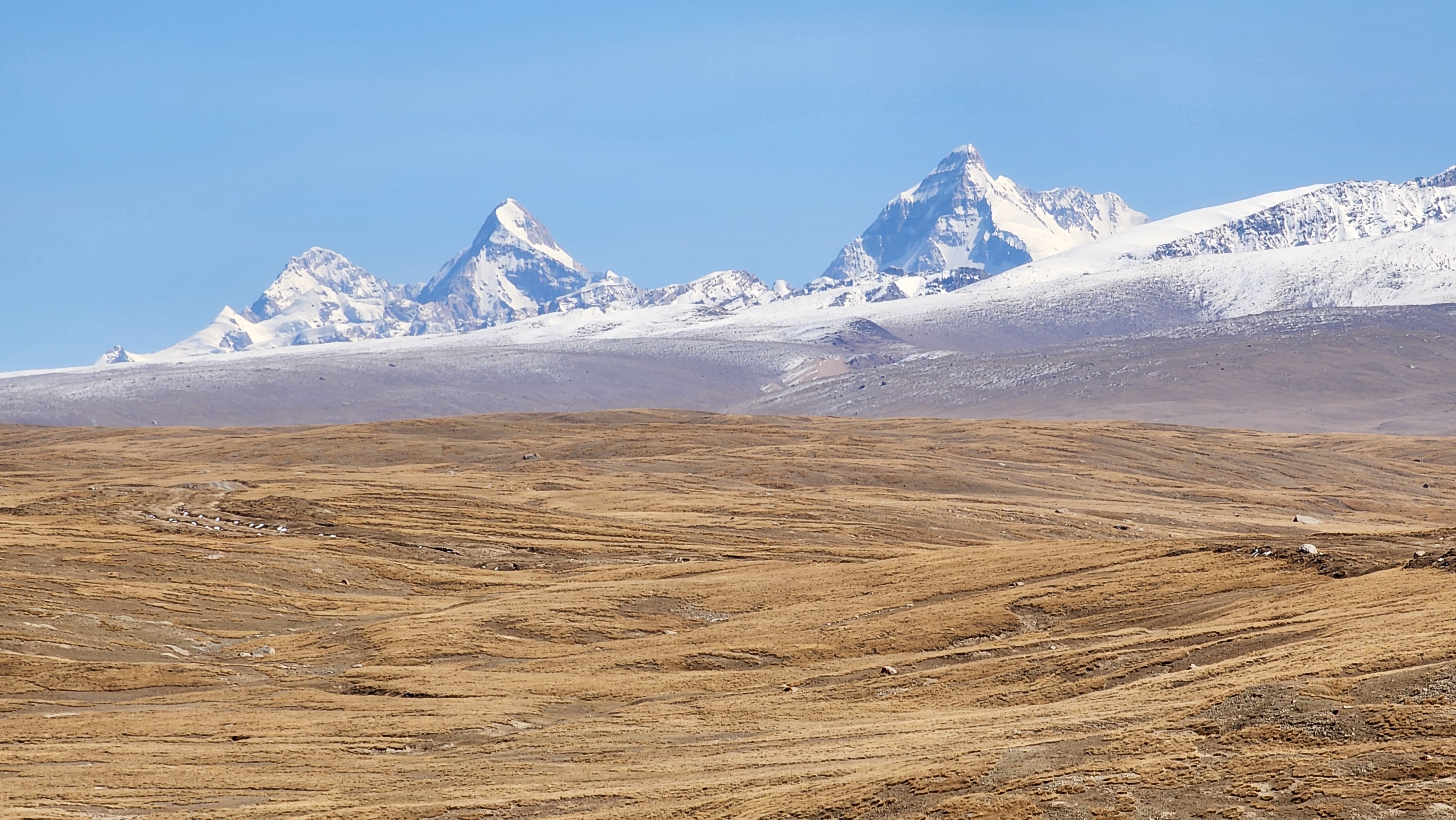
The Western Kokshaal-Too Range spans horizontally across Southern Naryn Oblast, forming the natural border between Kyrgyzstan and China's Xinjiang Region, providing some of Kyrgyzstan's most awe-aspiring peaks. The most notable and also the tallest mountain in the range is Peak Dankova, just shy of 6000 meters (5982m); and on another note, overlooking the Taklamakan Desert in Western China, the summit of Peak Dankova has the largest line of sight on the planet. Other notable mountains in the region included Peak Kosmos and Kyzyl Asker, both of which were close to 6000 meters as well. Most of the regions summits were Russian names (as with much of Kyrgyzstan), as only a handful of people actually reached the Kokshaal-Too each year, and they were mostly Russian Mountaineers determined to conquer the largest peaks of the region with unnecessarily heavy backpacks filled with slabs of meat and potatoes. (I joke of course, but this is a somewhat accurate stereotype of Russian Climbers)
Landscapes, Flora & Fauna of The Western Kokshaal-Too
The Kokshaal Too Range in Kyrgyzstan consists largely of barren, open terrain, with wide valleys and jagged peaks forming the core of the range and rising prominently from the surrounding landscape. Vegetation is sparse, with plant life mostly limited to subalpine shrubs adapted to high altitude conditions.
On the far western foothills of the Kokshaal Too, sporadic patches of Tien Shan spruce occur up to 3,000 metres elevation. These patches are limited in extent and confined to sheltered areas of the lower slopes and valleys.
Despite its remoteness, the region is still actively used by nomadic shepherds. Seasonal grazing extends into the Kokshaal Valley, and domestic sheep and cattle are commonly present around the periphery of the Kokshaal Too proper.
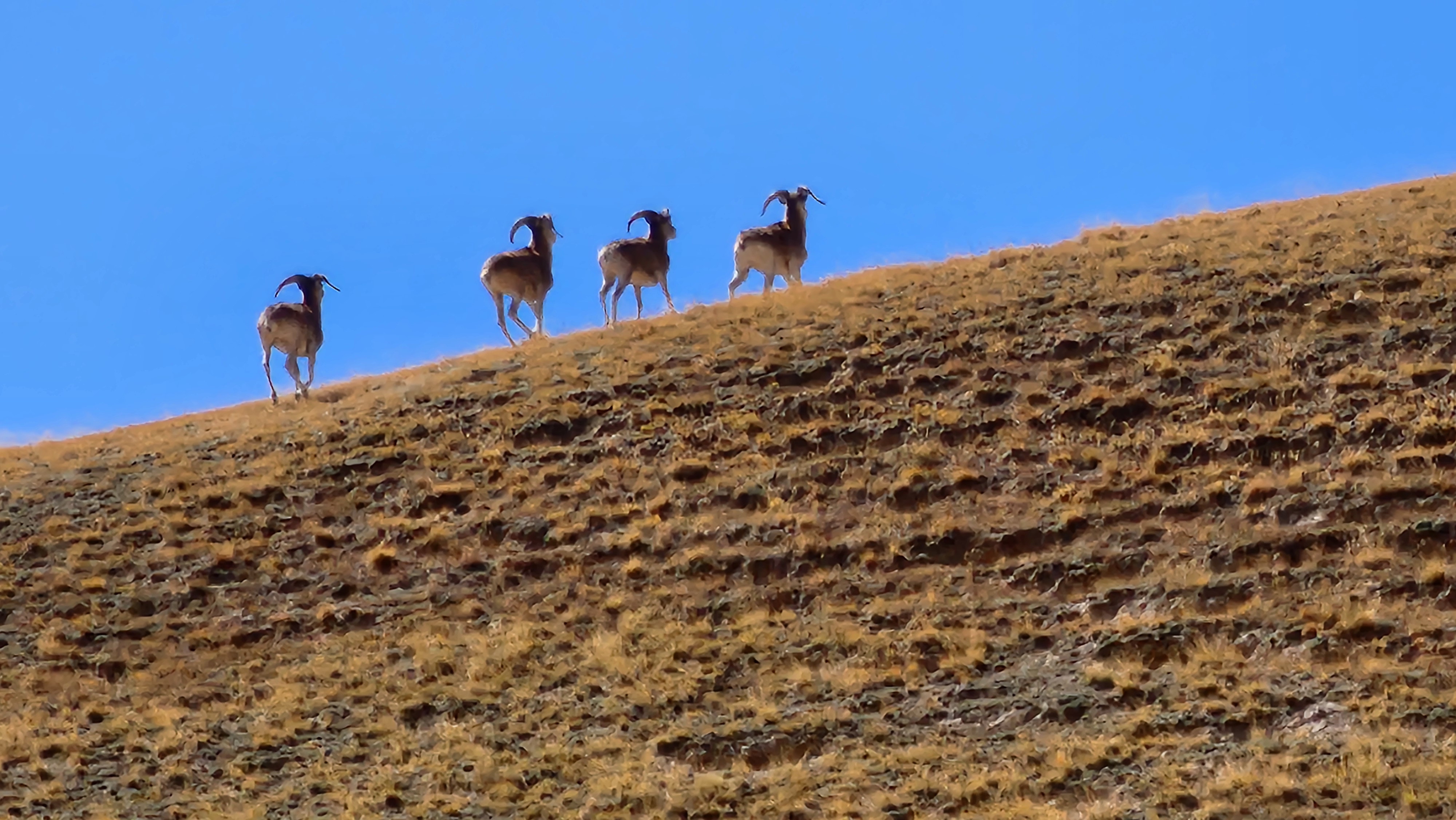
The Kokshaal Too also supports a diverse range of wild fauna, including snow leopards, Pallas cats, Tien Shan brown bears, corsac foxes, ibex, and notably large numbers of Marco Polo sheep.
Deep in the Kokshaal
If there’s one image that defines the Western Kokshaal-Too Range, it’s a deep blue lake sitting beneath the wall of peaks that form the main ridgeline. I’d seen the photo years earlier in a few Russian mountaineering trip reports. The lake is set against a backdrop of enormous, snow-covered mountains rising straight out of the wide Kokshaal Valley.
On day five of our trip, we woke up camped on its shores.
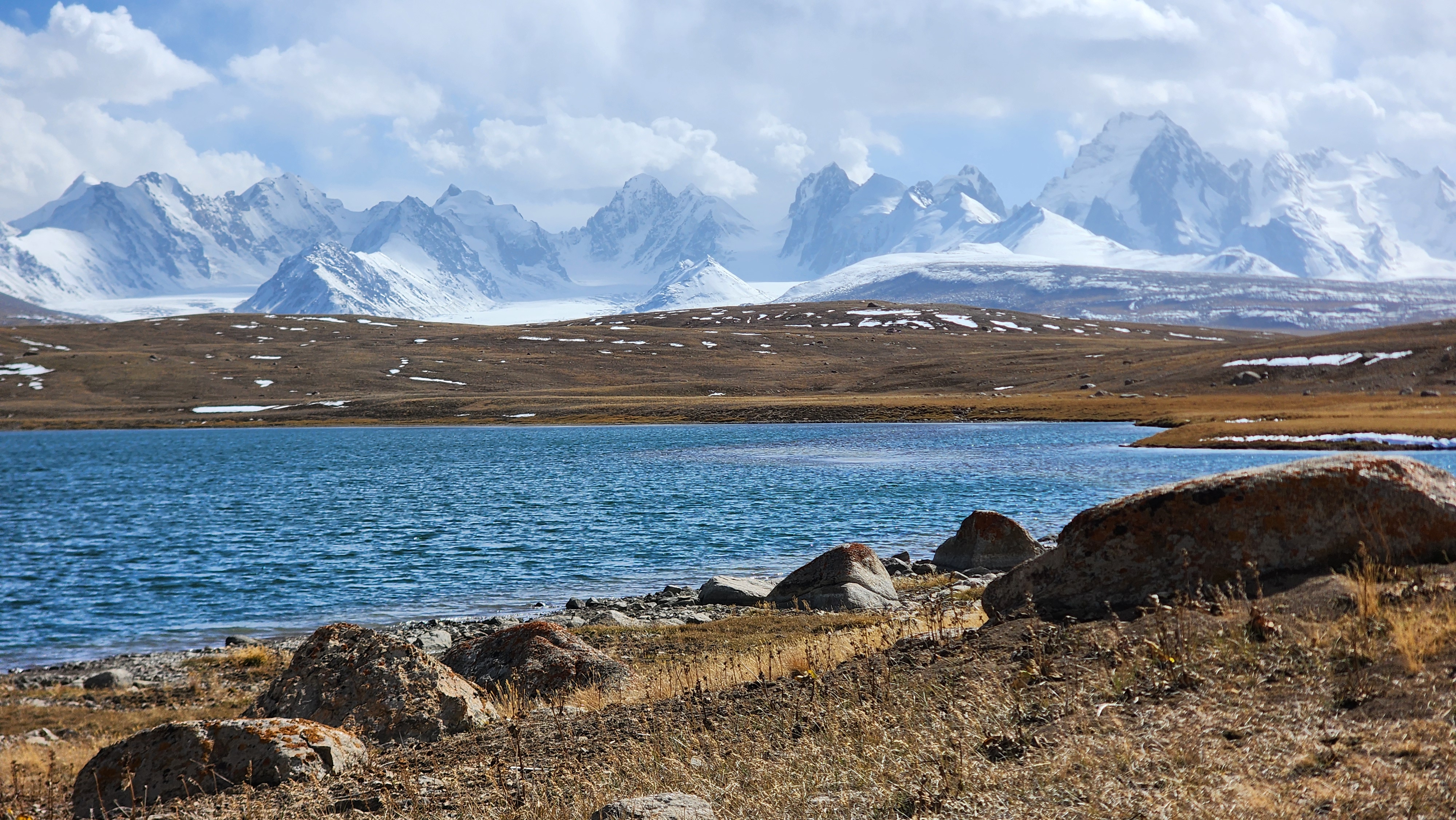
The lake itself is technically unnamed, sitting at roughly 3,500 metres, right on the edge of the Kokshaal Valley where the terrain begins to rise toward the main range.
The weather was far from perfect. Low clouds hung over the valley through most of the morning, hiding the peaks. Every now and then the cloud would lift just enough to reveal a glimpse of the mountains with huge, snow-covered peaks appearing briefly before disappearing again.
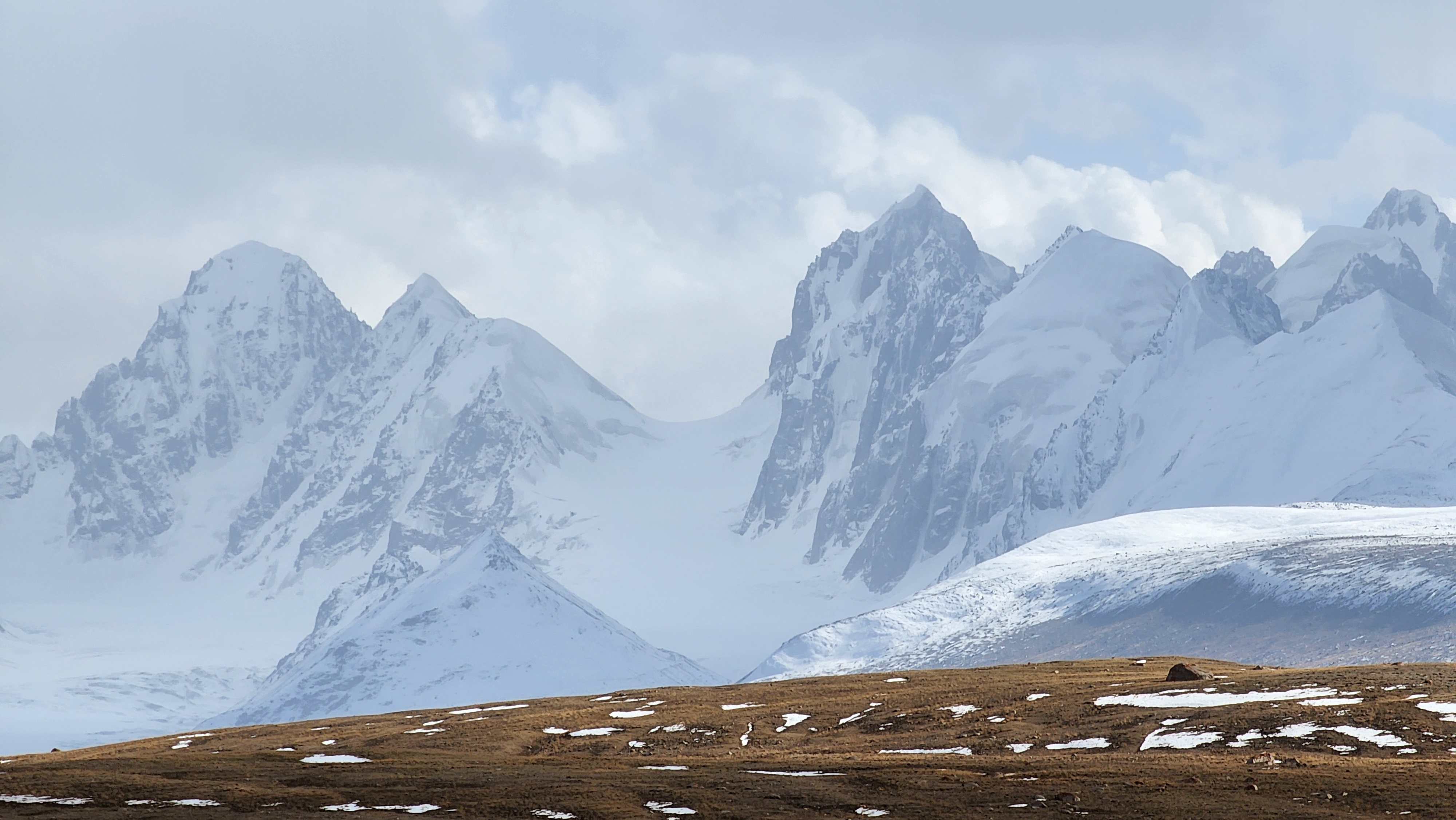
Late September at this altitude is cold. Overnight temperatures dropped to around –15°C, and any precipitation would almost certainly have fallen as snow.
Despite the weather, it may have been the most scenic campsite I’ve ever woken up to while sipping my morning coffee.
But the clouds weren’t lifting and we had ground to cover. Sitting around waiting for better weather didn’t make much sense. We packed up and began skirting the edge of the lake before climbing onto a broad, gently sloping plateau that led deeper toward the heart of the Kokshaal. Several streams cut across the plateau, forcing us to pick our way between crossings while trying our best to avoid wet feet so early in the day.
Attempting to jump one of the wider channels, I misjudged the distance and landed in the water, soaking my right foot completely.
Not an ideal start to the morning.
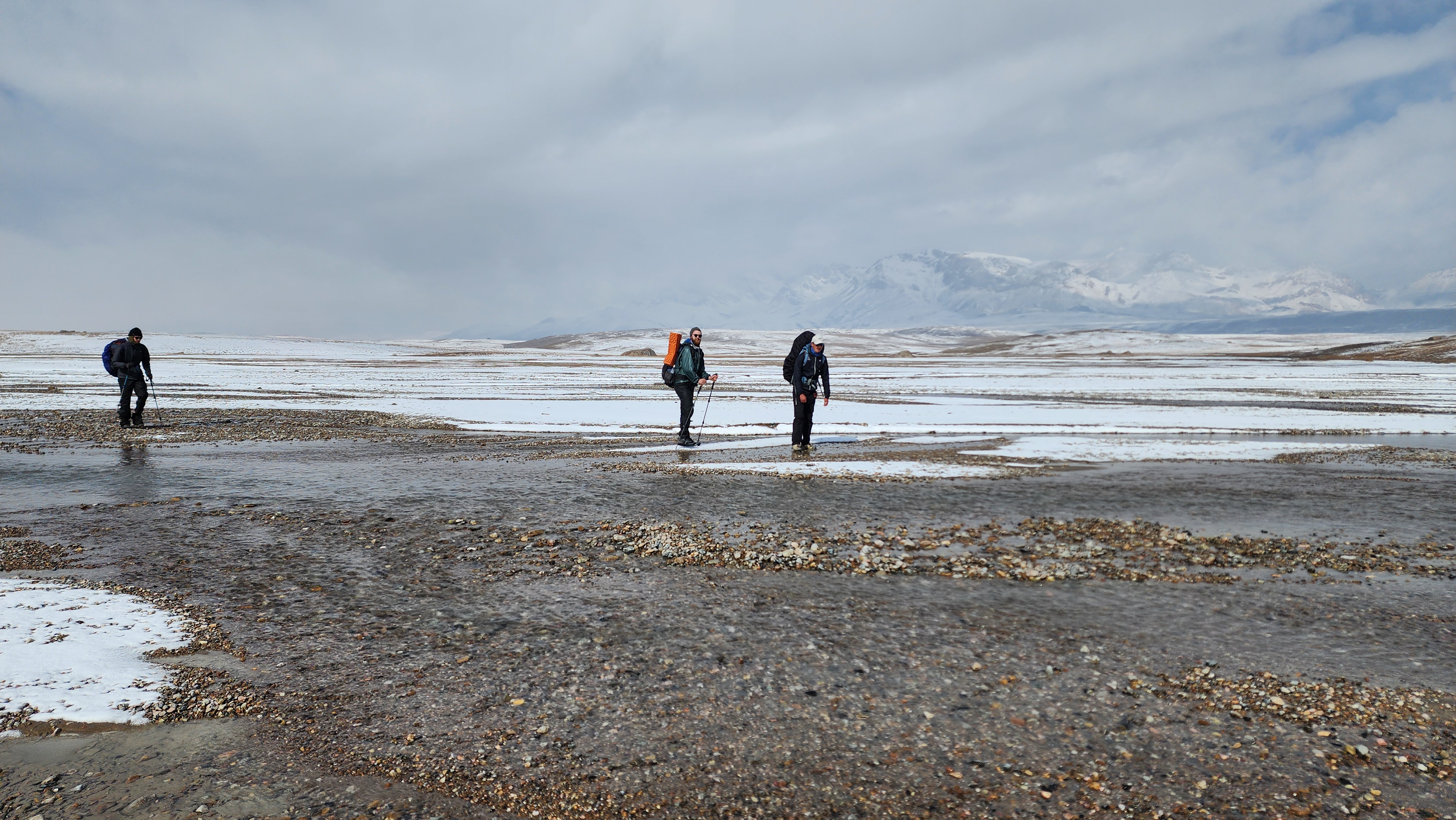
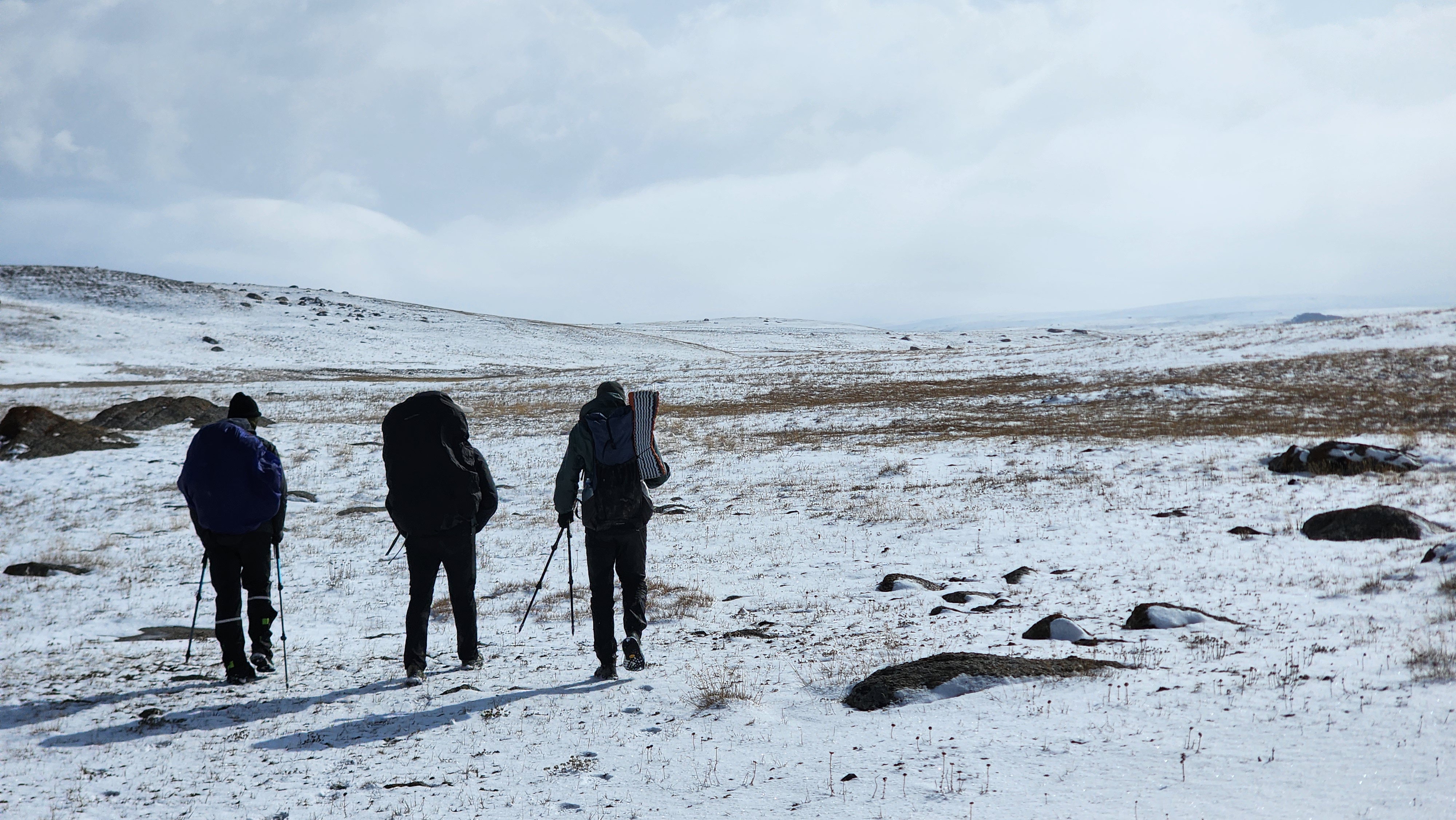
The weather only worsened as the morning went on. The temperature stayed bitter, the sky remained a solid grey, and before long the snow was coming down hard.
We were all freezing, but morale was strangely high. There was a strong sense of euphoria moving through the group, the realisation of just how wild and remote this place was. The falling snow only added to it. We were deep in the Kokshaal now, far from roads or settlements, walking through one of the most remote corners of Kyrgyzstan.
The terrain was easy and we made good progress. But as the snowfall intensified into a full whiteout, we had a decision to make. Our planned route climbed a high ridge ahead, another 500 to 600 metres of elevation gain. The alternative was to skirt around the ridge and stay lower.
Opinions were split.
In the end, somewhat predictably, Ian decided to go high. Equipped with one of the Garmin units, he headed straight toward the ridge, while myself, Robert and Ted, carrying the other device, chose the lower route around. There was a good chance he would catch us later anyway.
We said a quick goodbye and watched Ian disappear alone into the snow, gradually fading into the whiteout.
The three of us continued on, hoping the weather might improve. We still had a couple of passes to cross before finding a place to camp.
For the next few kilometres we moved through easy, shrubby terrain before the landscape suddenly changed. We found ourselves entering a small red canyon, narrow and winding, with rock formations that looked strangely reminiscent of something you might see in Utah. A cold stream ran along the canyon floor, narrow enough to jump across.
The canyon twisted through a series of maze-like passages, each with its own small channel of snowmelt water flowing down from above.
It was here that the sun finally made a brief appearance.
With a patch of blue sky overhead for the first time all day, we decided the canyon would make a good place for lunch.
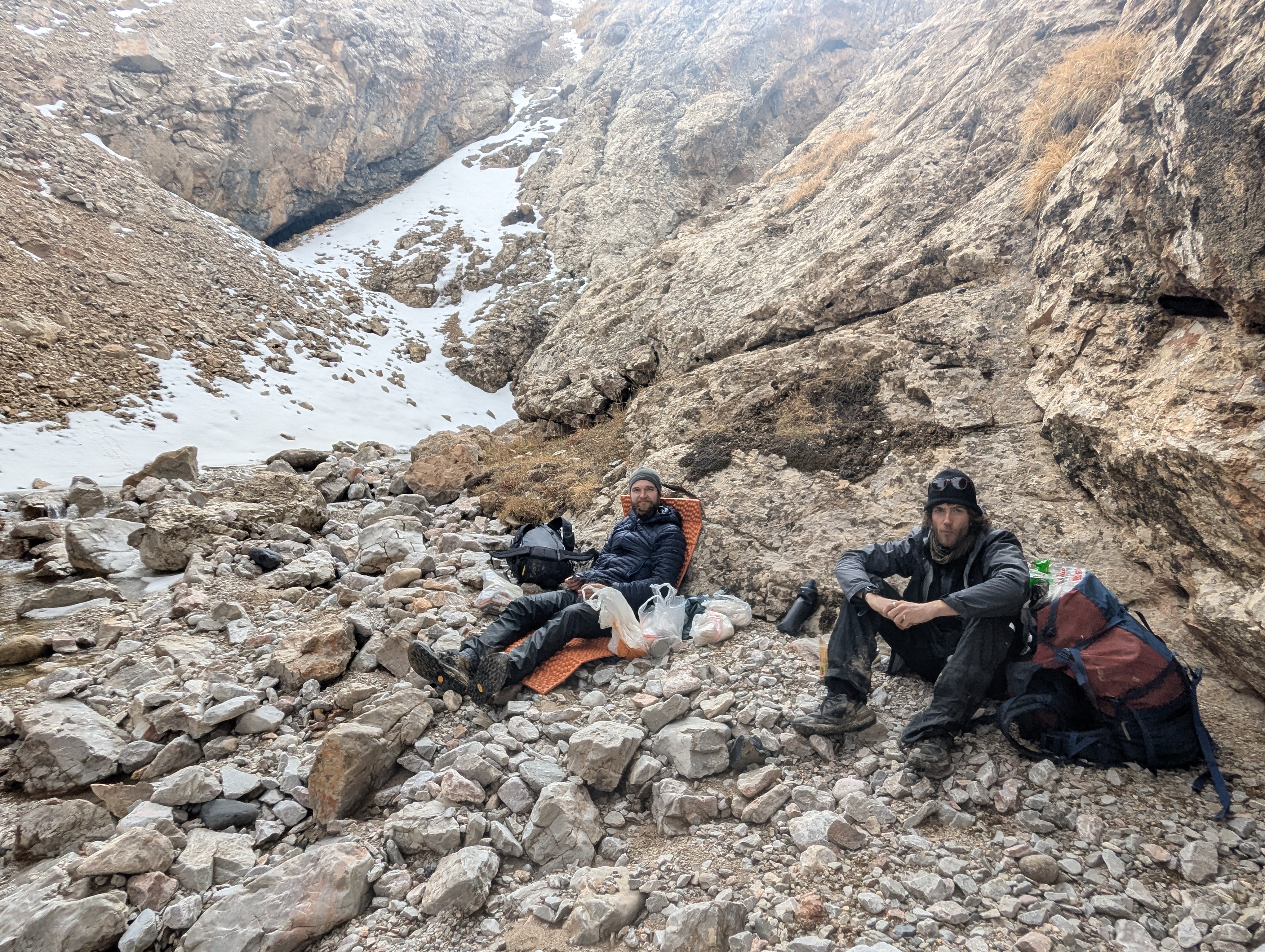
Lunch itself was fairly uninspiring. The remains of a now stale loaf of bread, black olives preserved in oil, and some Globus cheese. Globus is a supermarket chain in Kyrgyzstan. By this point I had also completely run out of my salami supply, which meant lunch had unexpectedly become vegetarian.
Not ideal.
While Robert and Ted finished eating, I wandered ahead to scout the terrain. We did not have a clear route to camp, just a general direction, so I tried to find a line that would keep us high enough to maintain views of the Kokshaal rather than dropping too deep into the valley.
It seemed luck was on our side. The route looked promising and would take us toward our final pass of the day.
Back on the move, the terrain steepened and fatigue began to set in. The steady climbing, the cold, and the long day were all starting to make themselves known.
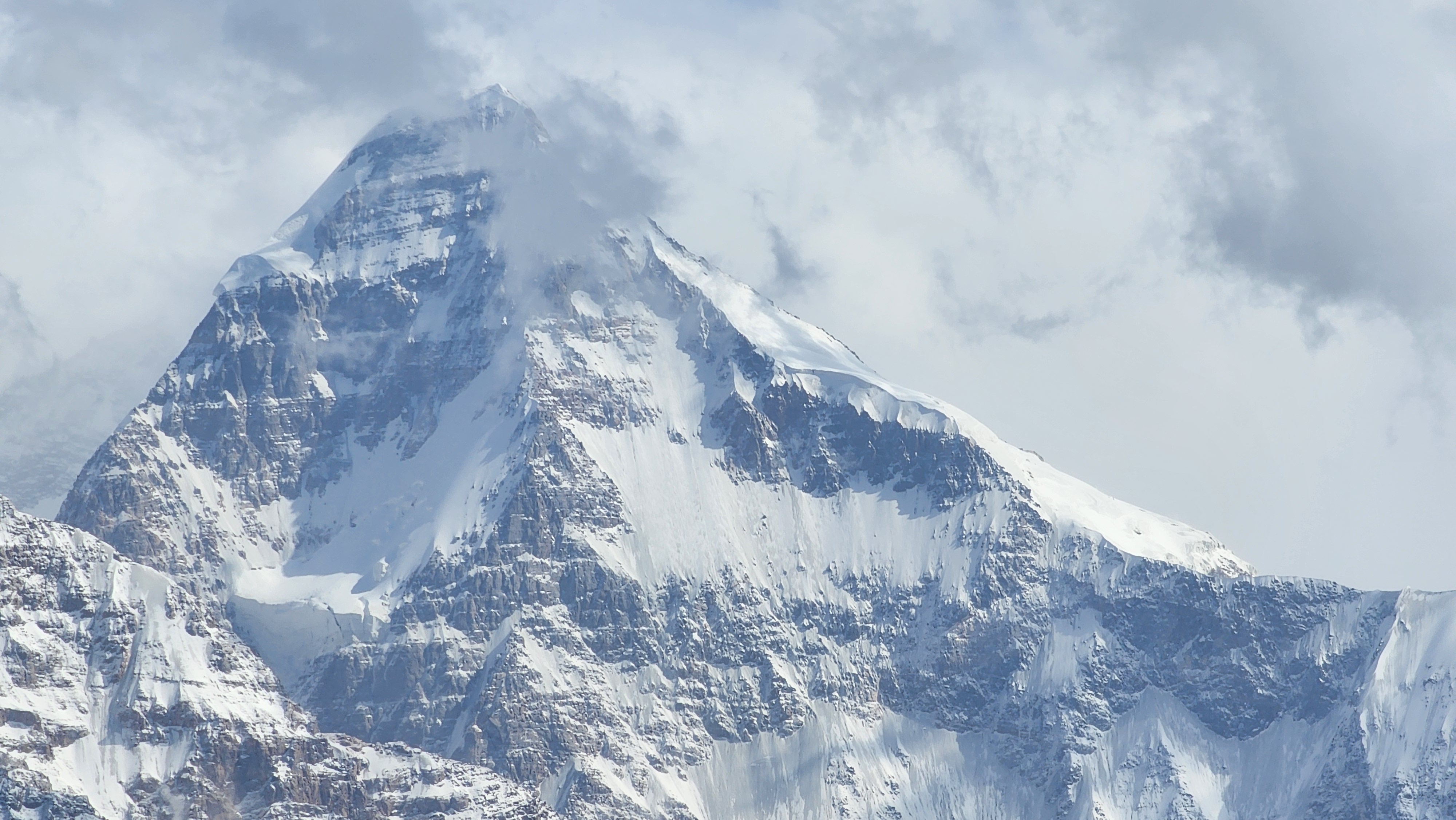
Just below the pass we spotted a group of Marco Polo sheep standing high on a distant cliff band. They had clearly noticed us well before we noticed them and kept a cautious distance, watching as we slowly made our way across the slope.
They probably wondered what on earth we were doing out there.
As we approached the pass there was still no sign of Ian. Given his pace, we assumed he must already be somewhere ahead.
We were wrong.
Less than fifty metres from the top, a tall, skinny figure suddenly appeared above us, running down the slope, desperately trying to reach us, screaming out!
Even from a distance there was no mistaking who it was.
Ian came flying down the hillside and joined us just below the pass in what felt like a strangely cinematic reunion after our temporary split.
With the full team back together, we crossed the pass and descended slightly, wrapping around a nearby hill that had been blocking the view behind it.
What appeared in front of us was easily one of the most memorable landscapes I have seen anywhere in Kyrgyzstan.
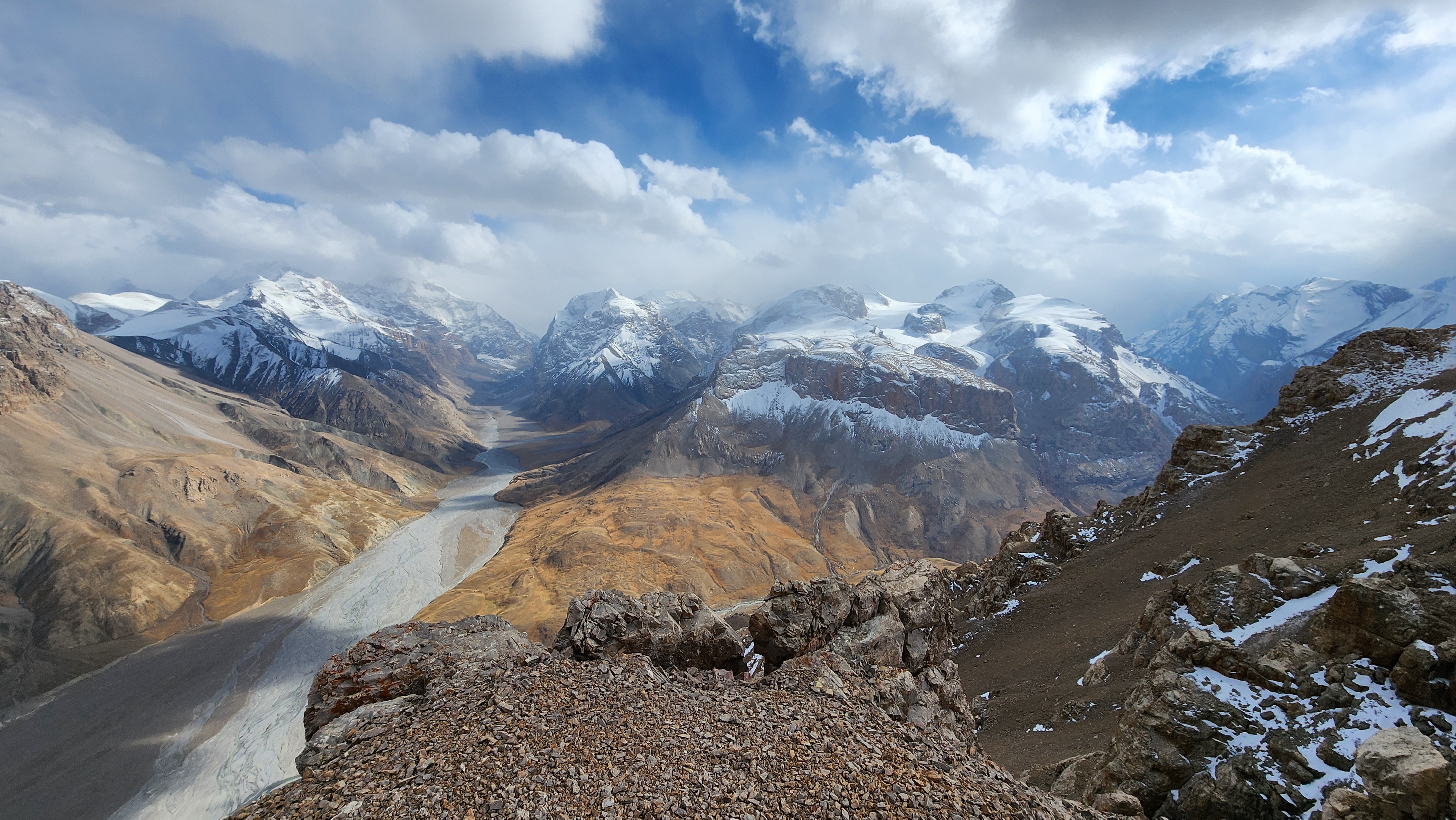
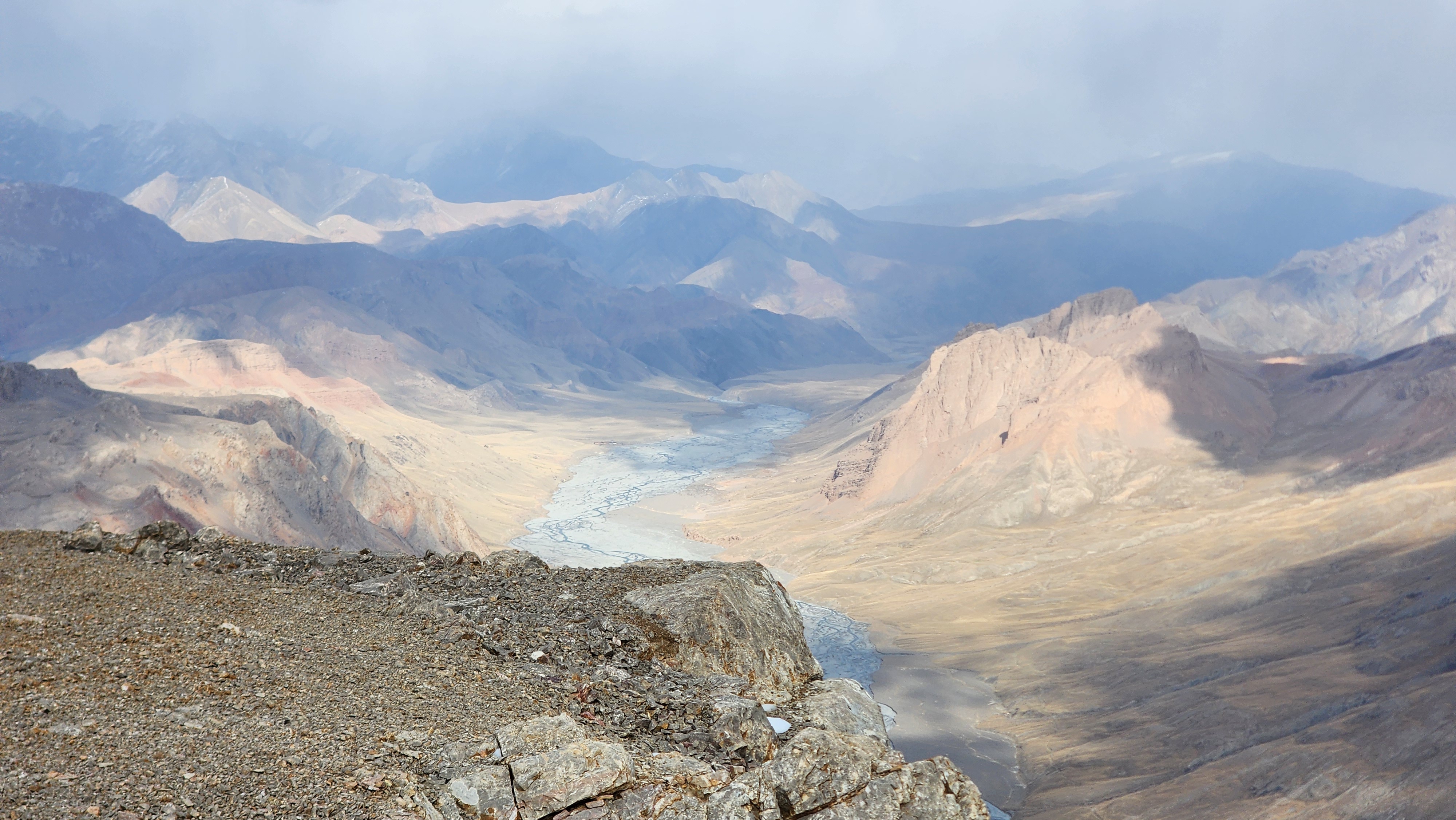
From this vantage point we could look back across the heart of the Kokshaal and forward into the Kotur Valley, which we would soon descend into.
I had seen plenty of spectacular mountain scenery across Kyrgyzstan, often more colourful, greener, and full of life. But the Kokshaal felt completely different.
It was barren, rugged and almost entirely lifeless.
The landscape had a harshness to it that felt both intimidating and beautiful at the same time. Nowhere else I had visited in the country carried quite the same feeling.
After spending some time taking it all in, we began descending toward the valley. The route down was not obvious. The slopes were steep and broken by cliffs in places, forcing us to carefully pick our way down.
Eventually we picked up a faint trail zig zagging through loose rock, which led us safely to the valley floor beside the Kotur River.
Further downstream we spotted several ibex running across the slopes in a clear state of alarm. They seemed spooked by something, though it definitely was not us as we were still far away.
Our immediate thought was a snow leopard.
It seemed like the most logical explanation for such sudden behaviour. We never saw anything ourselves, but it was a nice thought that the elusive predator might have been somewhere nearby.
By this point the final task of the day remained, finding a place to camp.
Originally we had planned to reach a large backcountry hunting lodge about six kilometres further down the valley. But daylight was fading quickly and several river crossings still lay between us and the lodge.
It was clear we would need to camp somewhere higher in the valley.
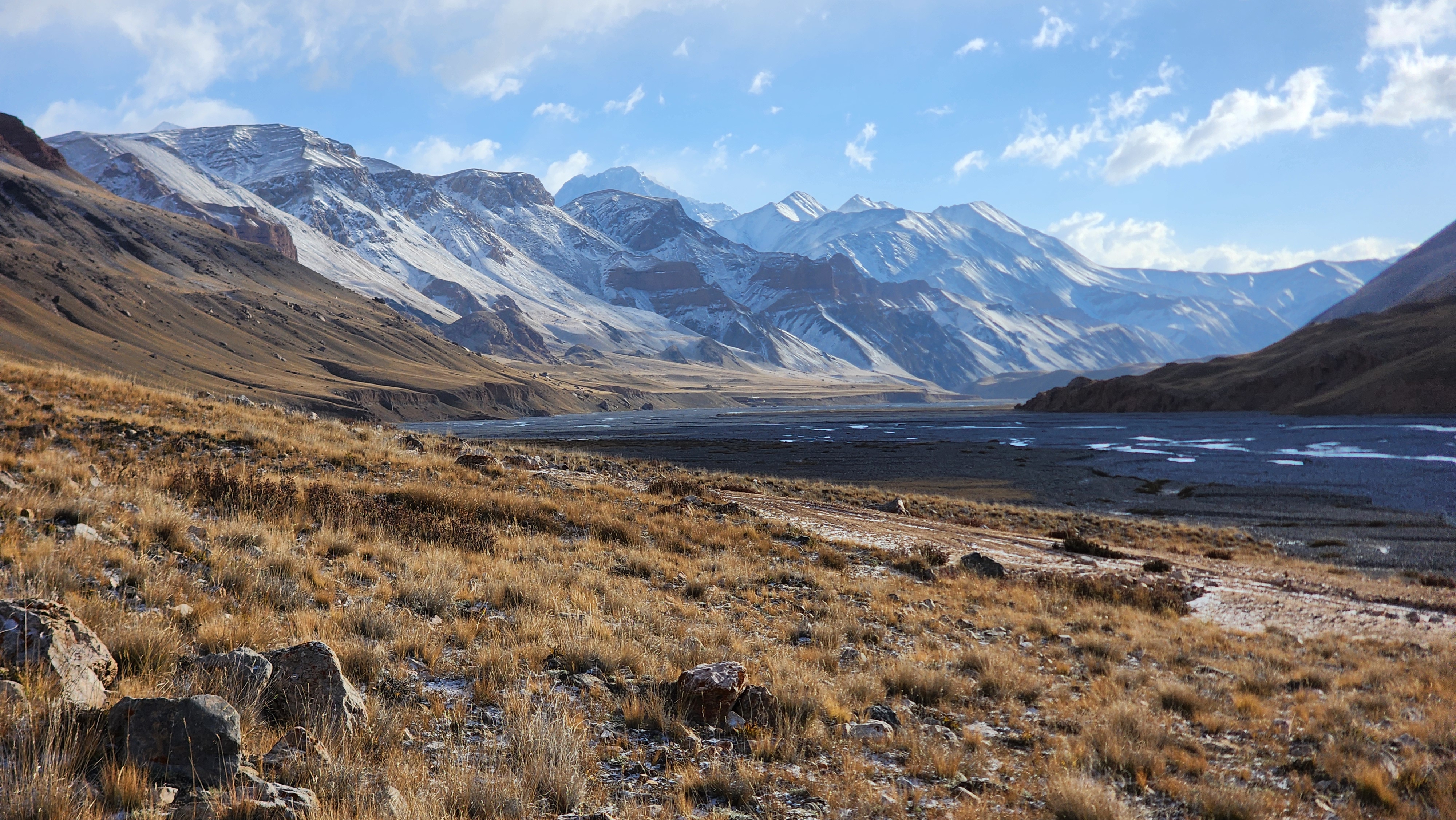
Eventually we settled on a far from perfect spot, windy, uneven, and with a long walk to the nearest water source.
Not ideal, but it would do.
With tents finally pitched, we settled in for the night, closing out what had been one of the most memorable days I have ever spent hiking in Kyrgyzstan.
In Conclusion
The purpose of this post was to provide a small insight into what was one of the wildest and most spectacular treks that Ian and I have completed across Central Asia.
I chose to focus on the fifth day of the trip because it felt like the true crux of the journey. It was the highest altitude we reached, the day with the most expansive views, and the moment when we travelled directly through the heart of the Kokshaal-Too Range.
Here we were walking beneath the towering peaks of the range, surrounded by mountains approaching 6000 metres, including Dankova, Kosmos, and several other giants of the Western Kokshaal-Too Range.
I personally connected with the Kokshaal Traverse expedition more than anywhere else in Kyrgyzstan because its character as a trek aligns closely with one of my core values: exploring the rarely explored. While Kyrgyzstan has been gaining more attention from travelers in recent years, the Kokshaal range still feels truly remote. Venturing into this region offered the chance to experience the country in its rawest form, far from the more commonly visited trekking routes.